

Key Events: AI CapEx concerns continue to mount
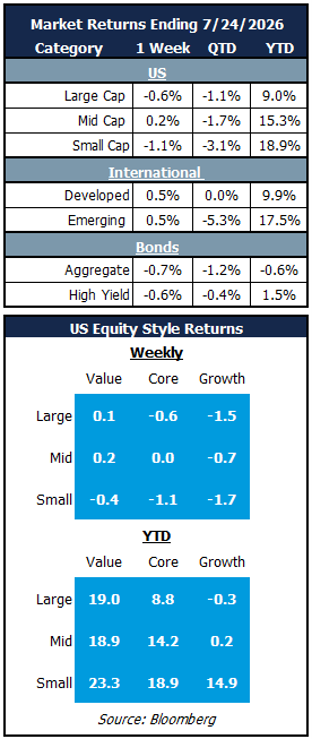
Second quarter earnings have delivered healthy results thus far, but guidance for higher capital spending plans from Google and weak results from Tesla cast a pall over the markets as the Nasdaq 100 fell 1.6% for the week. On the positive side, 8 of 11 sectors ended the week higher and the S&P Equal Weight index managed to eke out a positive return.1
Market review: Higher crude prices pressure yields
The S&P 500 lost 0.6%, falling for the second week in a row. Oil prices rose sharply, pushing the 10-year Treasury yield up 13 basis points to finish the week at 4.68%. The energy sector led the S&P 500, followed by utilities and industrials. Consumer discretionary and communications declined as Tesla, Amazon and Google pulled the Bloomberg Magnificent 7 index 5.7% lower.
Bonds sold off on rising interest rate expectations. International markets bucked the trend as developed and emerging markets both advanced.
Outlook: Spenders struggling as FCF plummets
The Bloomberg Magnificent 7 Index ended this past week in negative territory for the year-to-date. Given their strong performance since the end of 2022 and the intense concentration of the S&P 500 entering the year, this may come as shock to investors, especially considering the overall strength of market returns.
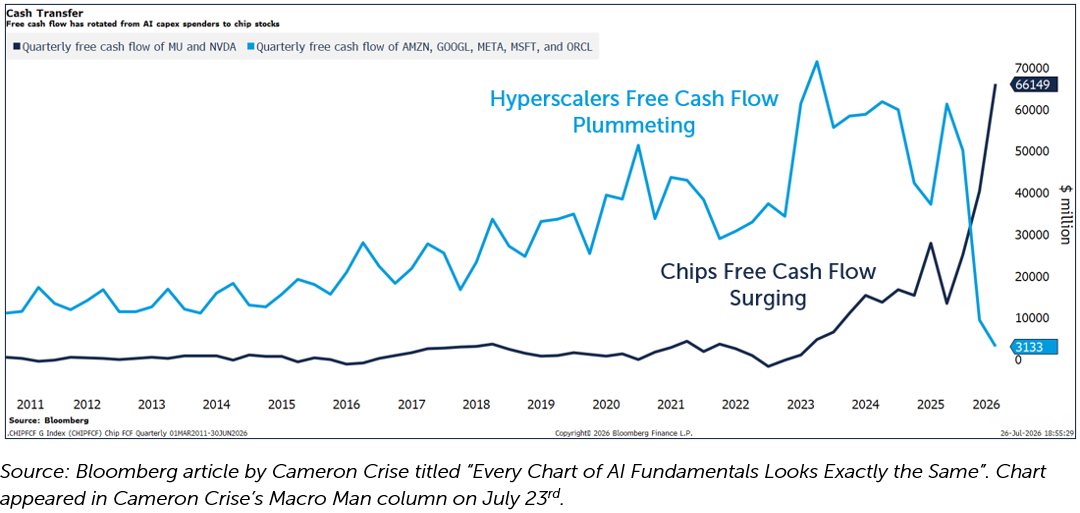
The ever expanding CapEx plans from the mega-cap hyperscalers are drawing increasing scrutiny as their free cash flow plummets amid rising concerns of future profitability from the AI buildout. Not all technology stocks are struggling, as the beneficiaries of capital spending are seeing a parabolic free cash flow boom to offset the decline experienced by the hyperscalers as shown in the chart below.
Concerns have been mounting as the cost of compute is starting to fall due to increased use of tokenization and new competitive offerings at a time when component prices have risen so dramatically that the cost of data center builds has increased well above original specifications. This is pointing to potentially lower profitability than many expected and the higher CapEx plans are pointing to higher capital intensity.
The capital light, high free cash flow yield story for the hyperscalers is officially in the rear view and investors have noticed. The broadening of markets has naturally coincided with this development, and the benefits of diversification have been on display throughout 2026. We continue to advocate for healthy diversification across geography, market capitalization and style and view risk management as paramount features of portfolio construction in today’s technological transition.
Free Cash Flow Hand-off from Hyperscalers to Chips
OneAscent Navigator Outlook: July 2026
This material is intended to be educational in nature, and not as a recommendation of any particular strategy, approach, product or concept for any particular advisor or client. These materials are not intended as any form of substitute for individualized investment advice. The discussion is general in nature, and therefore not intended to recommend or endorse any asset class, security, or technical aspect of any security for the purpose of allowing a reader to use the approach on their own. Before participating in any investment program or making any investment, clients as well as all other readers are encouraged to consult with their own professional advisers, including investment advisers and tax advisors. OneAscent can assist in determining a suitable investment approach for a given individual, which may or may not closely resemble the strategies outlined herein.2
1) Source: Bloomberg data.
2) Market Returns reference the following indices: Large Cap – S&P 500, Mid Cap Growth – Russell Midcap growth, Mid Cap Value – Russell Midcap Value, Small Cap – Russell 2000, Developed – MSCI EAFE, Emerging – MSCI Emerging Markets, Aggregate – Bloomberg US Aggregate, High Yield – Bloomberg High Yield