

Key Events: Bessent’s interventions raising concerns
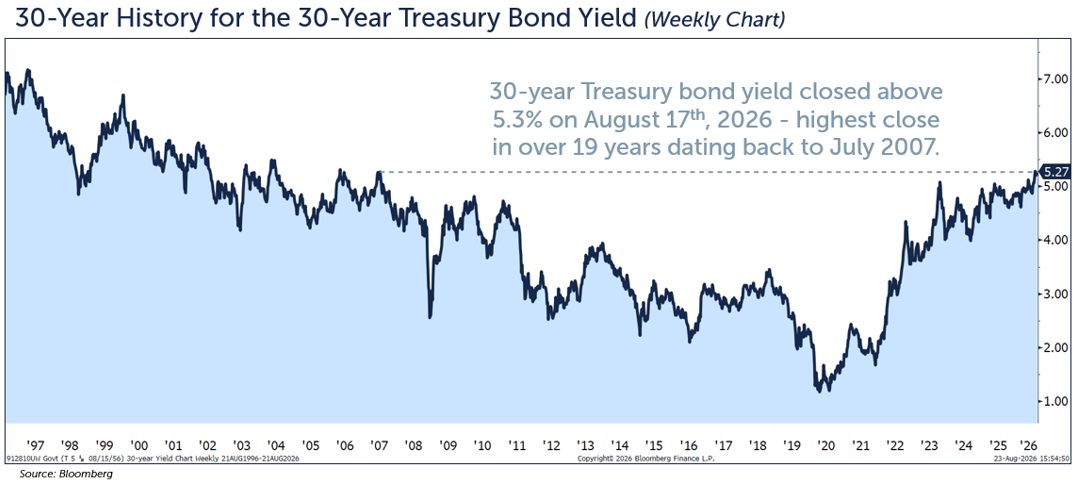
The 30-year US Treasury Yield hit a 19-year high last week .1 Stubborn inflation concerns, a large and widening deficit, AI related corporate issuance competing with treasuries and total public debt reaching $40 trillion have all contributed to recent weakness in the bond market. Treasury Secretary Bessent announced Wednesday that the department’s buyback operations would “at least double” (up to $4 billion per operation), effective September 9th.2 Yields fell sharply on the announcement, but the move unwound the next day as concerns regarding the effectiveness of the operation emerged.
Market review: Risk assets recede on rate volatility
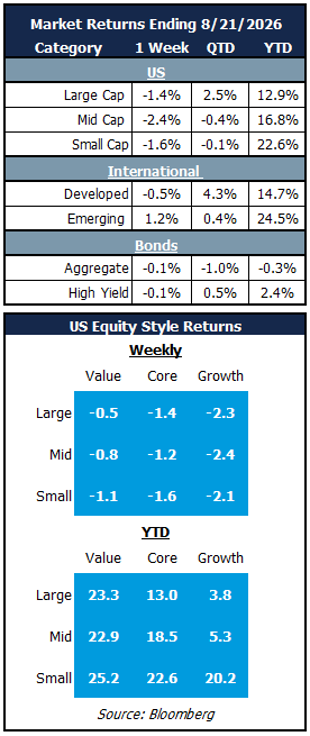
Domestic risk assets fell for the week, and the US dollar index fell more than 80 basis points. Developed International stocks outperformed US equities and emerging markets managed to buck the trend with a solid advance. Bonds gyrated throughout the week but eventually settled lower after digesting the Treasury Secretary’s buyback plans.
Outlook: Policy concerns becoming more acute
Long-term interest rates have climbed throughout 2026. The 10-year Treasury yield has risen more than 60 basis points this year to 4.74% as of Friday’s close and the 30-year yield closed at a 19-year high last week of 5.27%.3
Many observers see today’s rates as high only relative to the post GFC era, when rates averaged in the mid-3% range for over a decade. It may be more accurate to call this a return to normal, as the period gives way to fiscal dominance, wartime spending and a capital spending boom. These forces are pushing nominal GDP growth, inflation and yields higher. With government debt running at 100% of GDP and a growing budget deficit adding to the already high interest burden for the government, policy uncertainty is intensifying.
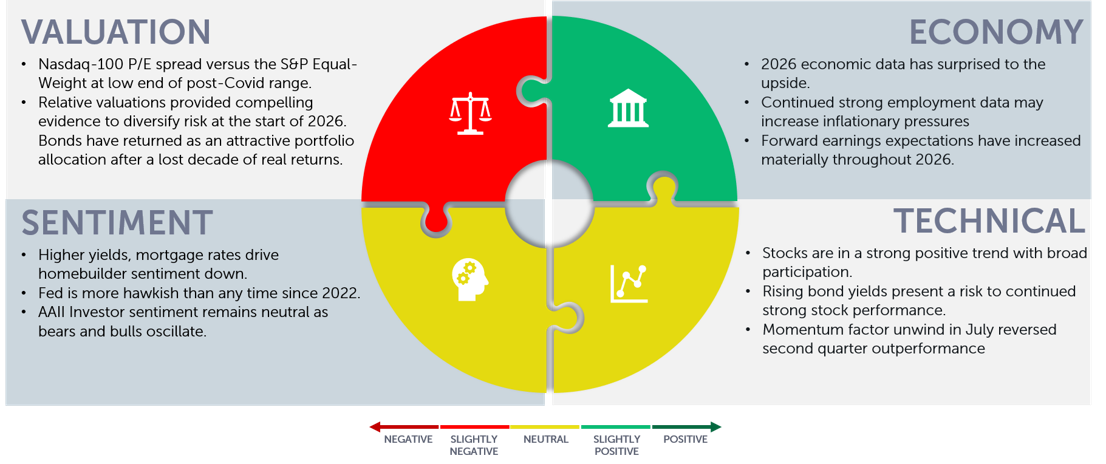
Markets will be looking for clues on the Fed’s next move when Chair Kevin Warsh delivers his keynote at Jackson Hole later this week. As we await his read on the economy and any signal on policy adjustments, we continue to believe investors should stay diversified across asset classes and anchor portfolios to long-term goals with commensurate risk levels.
OneAscent Navigator Outlook: August 2026
This material is intended to be educational in nature, and not as a recommendation of any particular strategy, approach, product or concept for any particular advisor or client. These materials are not intended as any form of substitute for individualized investment advice. The discussion is general in nature, and therefore not intended to recommend or endorse any asset class, security, or technical aspect of any security for the purpose of allowing a reader to use the approach on their own. Before participating in any investment program or making any investment, clients as well as all other readers are encouraged to consult with their own professional advisers, including investment advisers and tax advisors. OneAscent can assist in determining a suitable investment approach for a given individual, which may or may not closely resemble the strategies outlined herein.4
1) Source: Bloomberg data.
2) Source: Bloomberg news story “Bonds, Walmart Results Snap Stocks Rally: S&P 500 Week in Review”, dated August 21, 2026.
3) Source: Bloomberg data.
4) Market Returns reference the following indices: Large Cap – S&P 500, Mid Cap Growth – Russell Midcap growth, Mid Cap Value – Russell Midcap Value, Small Cap – Russell 2000, Developed – MSCI EAFE, Emerging – MSCI Emerging Markets, Aggregate – Bloomberg US Aggregate, High Yield – Bloomberg High Yield
OAI01608