

April stages a sharp recovery in risk assets
April marked a decisive break from March’s market stress, with risk assets staging an aggressive rebound despite escalating geopolitical tensions. While the conflict with Iran reintroduced tail‑risk concerns and drove renewed volatility in energy markets, broader financial conditions proved more resilient than expected. Manufacturing and retail sales data pointed to positive underlying momentum, the labor market stabilized, and risk appetite recovered quickly. Inflation pressures persisted—and expectations firmed—as oil prices surged and markets reassessed supply risks and transport vulnerabilities. Importantly, the shock remained largely contained to commodities rather than cascading into systemic stress, allowing a robust return to risk‑taking.
Equity markets were the clearest expression of that resilience. The S&P 500 surged throughout April, delivering its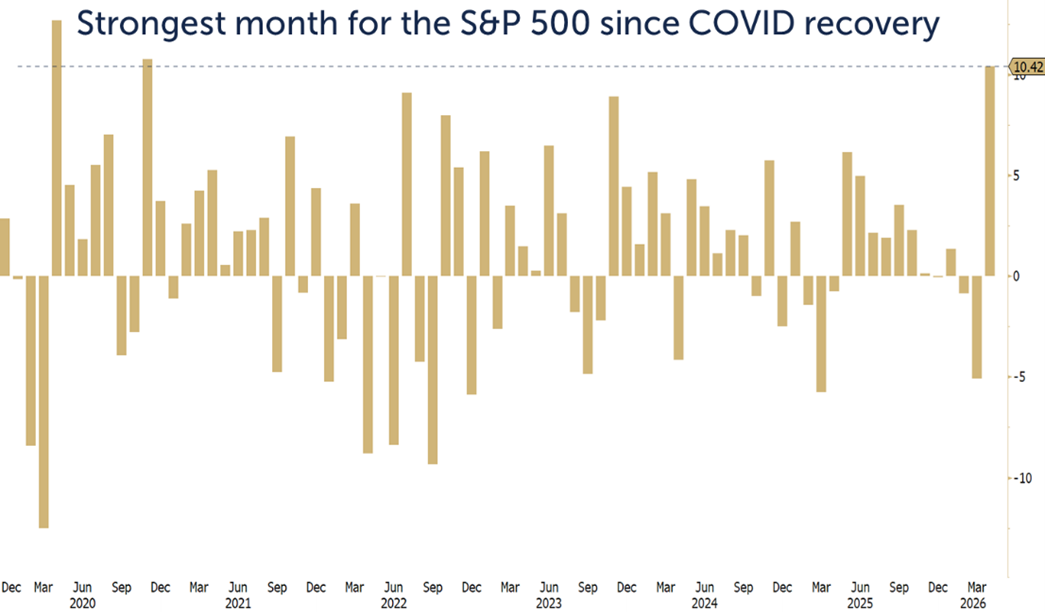 third‑strongest monthly gain in the last thirty years. The rally was broad and persistent, driven by improved risk appetite, stabilizing macro expectations, and strong technical momentum following March’s pullback.
Fixed income told a more cautious story. Treasury yields drifted lower as investors weighed strong equity performance against geopolitical risk and lingering uncertainty around inflation and policy. Credit markets remained orderly but selective: investment‑grade spreads widened modestly, while high yield showed greater dispersion as investors differentiated more sharply based on balance‑sheet strength.
April ultimately highlighted a notable divergence beneath the surface. Public equity markets embraced risk aggressively, producing a historic rebound, while other asset classes reflected a more guarded reassessment of fragility, liquidity, and geopolitics. Markets proved capable of powering higher—but not without sharper lines between enthusiasm and caution. Historically, months of this strength often occur during a broader bottoming process and are frequently followed by additional gains, as momentum tends to be self‑reinforcing. We will discuss how April’s strength fits with the persistent geopolitical uncertainty we can all see and feel, but first let’s review the details of April’s market performance.
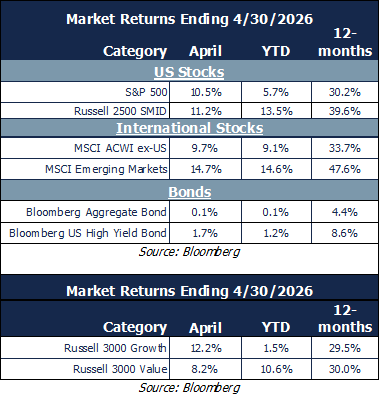
April Market Review
Markets roared back in April:
- International equities bore the brunt of the sell-off as the Middle East conflict likely impacts their economies more significantly due to the general lack of energy independence.
- U.S. small and mid‑cap stocks again outpaced mega‑ caps but all capitalization ranges scored double-digit returns, driven by a reassertion of growth sectors.
- Bonds gained as rates stabilized and high yield benefitted from the overall risk-seeking trend.
The Mag-7 technology stocks reasserted their dominance in April:
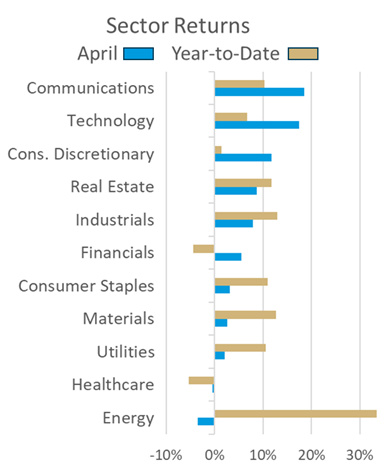
- Alphabet drove communications services higher as earnings blew through expectations and the outlook for AI-related spending was viewed positively, in contrast to META, whose AI-related spending was viewed as too high when paired with slower user growth.
- Technology stocks rode the strength of the semiconductor sector’s 38% monthly gain.
- Consumer discretionary rose on strong results from Amazon’s strong outlook for its AI-related business.
- Energy took a breather after March but remains up 30% for the year amidst geopolitical uncertainty.
Our Navigator framework informs our outlook.
May 2026 Navigator Outlook
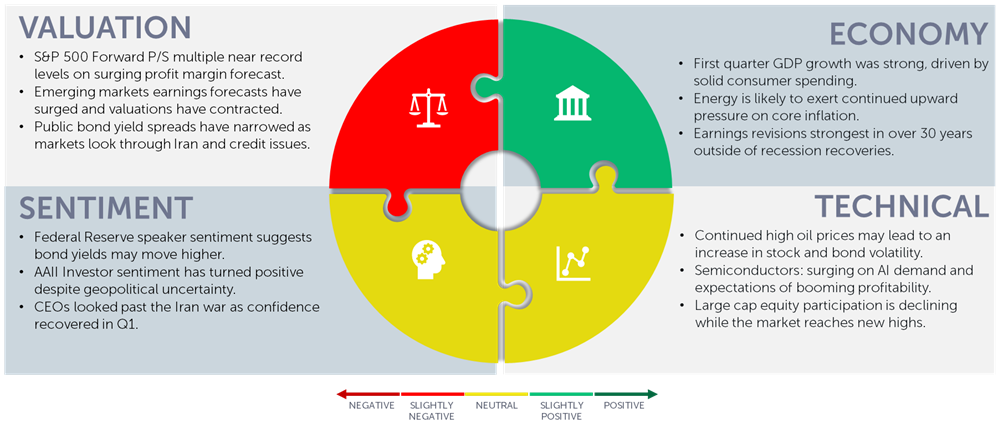
Economy: First quarter GDP growth was strong, driven by solid consumer spending. Earnings revisions have been the strongest in over 30 years outside of recession recoveries. However, energy is likely to exert continued upward pressure on core inflation.
Technicals: Continued high oil prices may lead to an increase in stock and bond volatility. Semiconductors have surged on the back of AI demand and expectations of booming profitability. Large cap equity participation is declining while the market reaches new highs.
Sentiment: Federal Reserve speaker sentiment suggests bond yields may move higher. AAII Investor sentiment has turned positive despite geopolitical uncertainty. CEOs appear to have looked past the Iran war as their confidence recovered in Q1.
Valuation: S&P 500 Forward price to sales multiple is near record levels on surging profit margin forecasts. Emerging markets earnings forecasts have surged and valuations have contracted. Public bond yield spreads have narrowed as markets look through Iran and credit issues.
Outlook and Recommendations: Managing through a murky outlook
While stocks are hitting new all-time highs, market participants enter May in a more unsettled mood as investors reassess the trajectory of monetary policy. Economic data remains broadly resilient, but the policy backdrop has become less predictable. The arrival of a new Federal Reserve Chair—combined with the first meaningful dissents in several years—has introduced a degree of uncertainty that markets are still working to price. The message from the Fed is no longer monolithic, and the path of rate cuts is now more conditional, more data‑dependent, and more openly debated within the Committee.
Despite this, the underlying economic picture remains constructive. Job growth continues at a steady pace, consumer spending is holding up, and investment in productivity‑enhancing technologies remains a durable tailwind. Inflation progress has slowed but not reversed, and the economy continues to show an ability to absorb higher rates without losing momentum. Internationally, fundamentals are gradually improving, with Europe stabilizing and several emerging markets benefiting from earlier easing cycles and strengthening earnings trends.
Market performance remains supported by strong earnings revisions – S&P 500 earnings are projected to rise 27%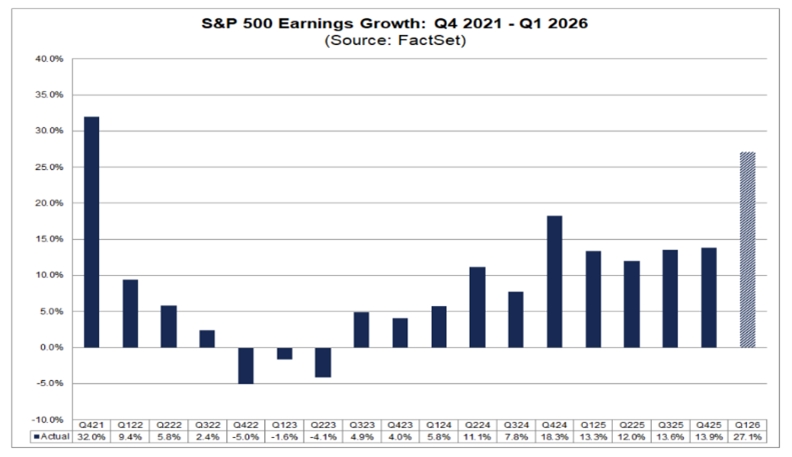 from the fourth quarter(see chart to the right). The dominance of mega‑cap technology stocks is still present, but is giving way to more broad participation – the “other 493” stocks earnings are projected to be up double-digits, quite respectable if they weren’t contrasted to the 61% earnings gain of the “magnificent 7”.1
Valuations outside the largest U.S. names remain attractive, and earnings trends abroad continue to improve. The equal‑weight versus market‑weight performance and rolling U.S. versus international comparisons still point toward a broadening tend – one that appears structural rather than tactical.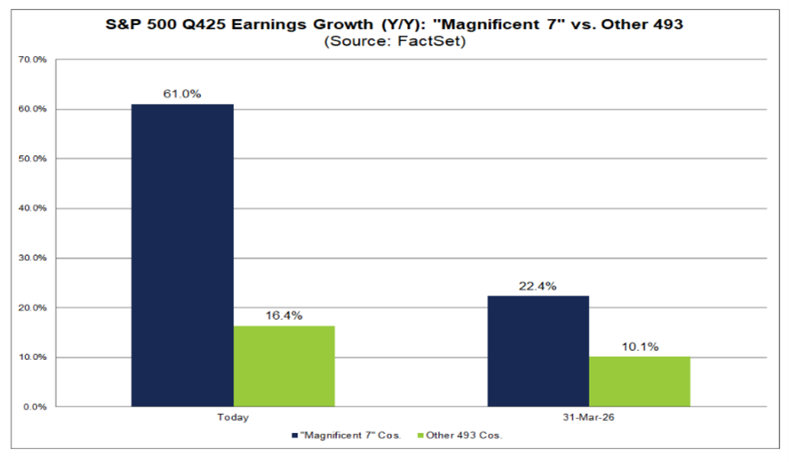
Even so, dispersion remains high. Beneath the calm of headline indices, a meaningful share of companies continue to experience sharp drawdowns. This underscores the importance of thoughtful portfolio construction—participating in the broadening trend while avoiding the weakest balance sheets and most stretched valuations.
Geopolitical tensions also remain a source of short‑term volatility, 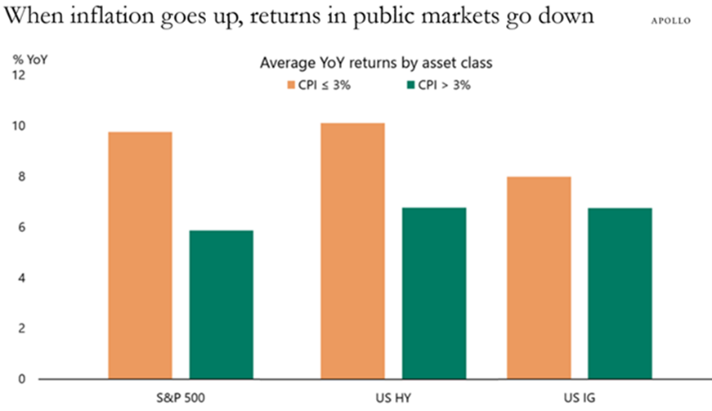 particularly given the inflationary potential of higher oil prices. As seen in the chart to the left, higher inflation tends to take a toll on asset returns2. While geopolitical events often exert a short-term influence on sentiment and commodity prices, their long‑term impact on diversified portfolios has historically been limited. The U.S. economy’s position as a net energy exporter continues to cushion the domestic effects of oil‑related disruptions. The longer the conflict lasts, though, the likelier that higher oil prices exert an upward pull on inflation.
Overall, the investment landscape entering May is more nuanced but still supportive. Economic fundamentals remain resilient, market leadership is widening, and valuations outside the mega‑cap cohort continue to offer compelling long‑term opportunities. The increased uncertainty around monetary policy is real, but it is not a reason to abandon discipline. Staying diversified, patient, and focused on fundamentals remains the most effective approach in an environment where volatility and opportunity continue to coexist.
Portfolio Construction and Positioning
Our Navigator process helps guide our portfolio construction:
- Mid-cap and international equities: These segments offer attractive valuations relative to U.S. large caps and provide long-term diversification benefits.
- Balanced exposure across styles: We maintain a mix of growth stocks currently benefitting from technological innovation and value stocks offering upside potential with an emphasis on cash flow and dividends.
- Fixed income remains compelling: Bond yields exceed the earnings yield of large-cap equities, and real (inflation-adjusted) yields are positive—supporting the case for continued fixed income exposure.
- Mortgage-backed securities: We see favorable risk-reward dynamics here as an increase in pre-payments from refinancing or sales could be a catalyst. Corporate credit spreads remain narrow, limiting upside in riskier sectors of the bond market.
- Alternative investments: We continue to find meaningful opportunities in both non-correlated strategies and private market investments.
Constructing portfolios that are resilient and capable of compounding effectively over time is our primary goal. We are mindful of the myriad of near-term risks but remain focused on the value of discipline and diversification.
This material is intended to be educational in nature, and not as a recommendation of any particular strategy, approach, product or concept for any particular advisor or client. These materials are not intended as any form of substitute for individualized investment advice. The discussion is general in nature, and therefore not intended to recommend or endorse any asset class, security, or technical aspect of any security for the purpose of allowing a reader to use the approach on their own. Before participating in any investment program or making any investment, clients as well as all other readers are encouraged to consult with their own professional advisers, including investment advisers and tax advisors. OneAscent can assist in determining a suitable investment approach for a given individual, which may or may not closely resemble the strategies outlined herein.3
1) Source: FactSet FactSet Earnings Insight
2) Source: Apollo Inflation’s Drag on Public Markets | The Daily Spark
3) Source: Market Returns reference the following indices: Large Cap – S&P 500, Mid Cap Growth – Russell Midcap growth, Mid Cap Value – Russell Midcap Value, Small Cap – Russell 2000, Developed – MSCI EAFE, Emerging – MSCI Emerging Markets, Aggregate – Bloomberg US Aggregate, High Yield – Bloomberg High Yield
OAI01524