

“Everything Everywhere All at Once”1
The final month of the first quarter of 2026 delivered a compounding escalation of military intervention in Iran and an abrupt reversal of the market’s broadening trend for risk assets. For many observers, the torrent of information made it feel as though world leaders, the media and the markets were all trying to process “Everything Everywhere All at Once” referencing the title of 2022’s Oscar winning film for Best Picture. There could be a deeper correlation to themes explored in the movie with current events, but the literal connection implied by the title expresses the magnitude of the global economic reach.
The long-term ramifications of hostilities in the Middle East are unlikely to be fully understood for a considerable period, but the economic outlook for the remainder of 2026 will be determined by the duration of the current war with Iran and the path of oil and gas prices over the coming months. The reopening of the Strait of Hormuz would certainly alleviate pressure on commodity prices, but the significant damage done to Middle East productive capacity may restrain the expected commodity price relief for global consumers. As a result, oil prices may stay elevated for some time even with a near-term resolution.
A variety of scenarios could unfold, but the direction of growth is weakening and the impulse for higher inflation is quickening as displayed in the March Interim Economic Outlook from the OECD.2 Fears of a sharp acceleration in inflation data with lower than expected growth are leading many economists to suggest at least a short-term stagflationary shock is in the cards.
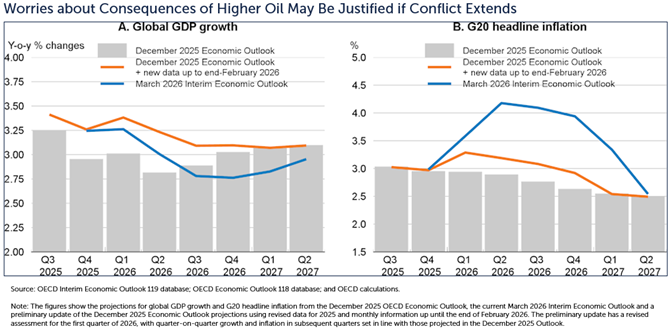
Before we delve further into the consequences of the macroeconomic outlook, let’s review how the last month unfolded:
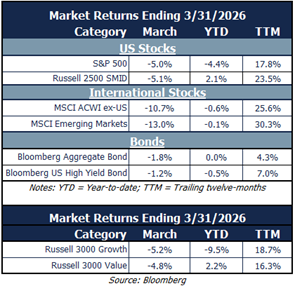
March Market Review
Risk assets retreated as rising oil prices and private credit worries mounted throughout the month:
- International equities bore the brunt of the sell-off as the Middle East conflict likely impacts their economies more significantly due to the general lack of energy independence.
- Small and mid-cap stocks were not spared during March, but they ended the first quarter in positive territory.
- Value retained a healthy year-to-date lead over growth but still fell nearly 5% in March.
- Bonds were negatively impacted by higher rates as the 10-year yield jumped over 35 basis points.
War with Iran drove March performance as a dramatic surge in oil prices reignited stagflation fears:
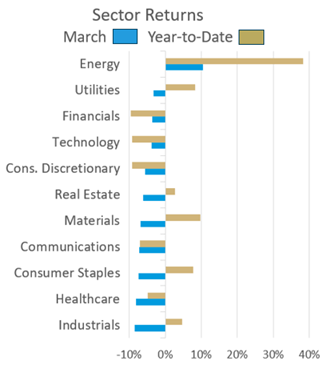
- Energy performed quite well and it was the only positive sector as the oil price increased more than 50% during the month.3
- Utilities and financials were the next best performers as they proved to be relatively more defensive than other sectors.
- Industrial, health care and consumer staples were the worst performing sectors in March. Industrials suffered from economic concerns and margin worries over higher input costs. Health care and staples lagged as higher interest rates impacted their defensive qualities.
- The market broadening observed during the first two months of the year reversed with the onset of the Iran conflict.
Our Navigator framework informs our outlook.
April 2026 Navigator Outlook
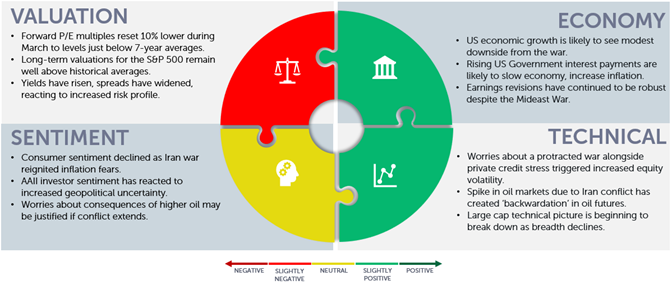
Economy: US economic growth is likely to see modest downside from the war. Rising US Government interest payments are likely to slow down the economy and increase inflation. Earnings revisions have continued to be robust despite the Mideast war.
Technicals: Worries about a protracted war alongside private credit stress triggered increased equity volatility. Spike in oil markets due to Iran conflict has created ‘backwardation’ in oil futures. Large cap technical picture is beginning to break down as breadth declines.
Sentiment: Consumer sentiment declined as Iran war reignited inflation fears. AAII investor sentiment has reacted to increased geopolitical uncertainty. Worries about consequences of higher oil may be justified if conflict extends.
Valuation: Forward P/E multiples reset 10% lower during March to levels just below 7-year averages. Long-term valuations for the S&P 500 remain well above historical averages. Yields have risen, spreads have widened, reacting to increased risk profile.
Outlook and Recommendations:
The global economy entered the year on a strong footing with solid momentum supported by strong earnings revisions. The US economic outlook included benefits from the One Big Beautiful Bill Act and expectations that at least two rate cuts were likely to support a robust consumer appetite for spending and investment in 2026. The onset of war in the Middle East triggered a strong enough spike in commodity prices to reduce interest rate cut expectations to very little if any change and essentially nullify the benefits from OBBBA.4
Consumer Sentiment and Recession Risk: Forecast consumer benefits from fiscal support and interest rate expectations may provide explanatory data for economists, but readings of consumer sentiment indicate how the consumer actually feels about current prospects. Current readings are near the lowest levels of the last 50 years according to the University of Michigan Consumer Sentiment Index. The recession of 1981, the Global Financial Crisis in 2008, S&P Ratings cut and European debt crisis in 2011 and the high oil prices and stock market setback in 2022 are the only other times since the late 70’s that match the current extreme.
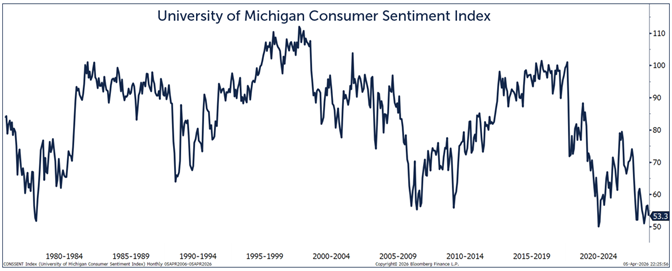
In addition, today’s weak consumer sentiment appears to be signaling a challenging few months ahead as consumers anticipate higher prices at the pump. While the probability of recession has risen since the onset of the war, the risk of recession still remains reasonably well contained as long as war doesn’t keep oil prices elevated for more than a few months.
The massive monetary and fiscal stimulus throughout the world coupled with the AI spending boom continue to buttress the global economy and support healthy earnings growth. These factors continue to support the remarkable resilience of the US economy.
Long-term lows in consumer confidence have historically been associated with good buying opportunities for risk assets and they have been accompanied by low valuations. That is not the case today.
Equity Valuations: Forward P/E multiples fell by roughly 10% between late February and the end of March for both the S&P 500 and the MSCI All-Country World Index. Equity prices did not fall quite as sharply for U.S. companies due to strong positive earnings revisions over the past month from several US based technology companies. The contraction in earnings multiples brought the current price-to-earnings level below the trailing 7-year average for both series as shown below. Also, note that the valuation gap remains nearly double the spread exhibited the year before the pandemic.
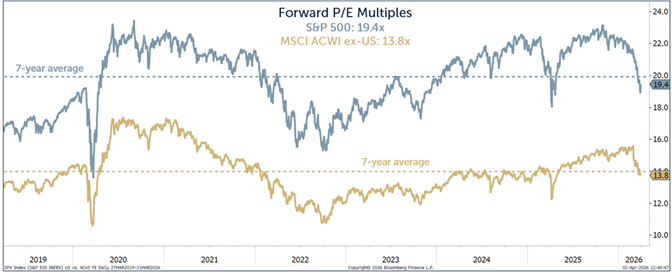
While the lower P/E multiple should provide some comfort that frothy valuations have subsided, US equities are still far from cheap. The shorter timeframe could be considered illusory compared to a longer-term viewpoint.
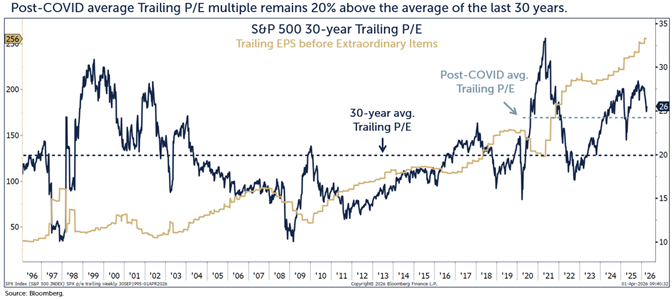
The chart on the next page examines the evolution of the ‘Trailing P/E ratio’ for the S&P 500 instead of using forward earnings, which often prove to be optimistic. The 30-year average for the S&P 500 Trailing P/E multiple hovers near 20x and the Post-COVID Trailing P/E multiple exceeds 24x. The Post-COVID period of AI expansion may be deserving of a 20% valuation premium, but investors should be mindful to account for the historical premium in their assessment of potential downside risk.
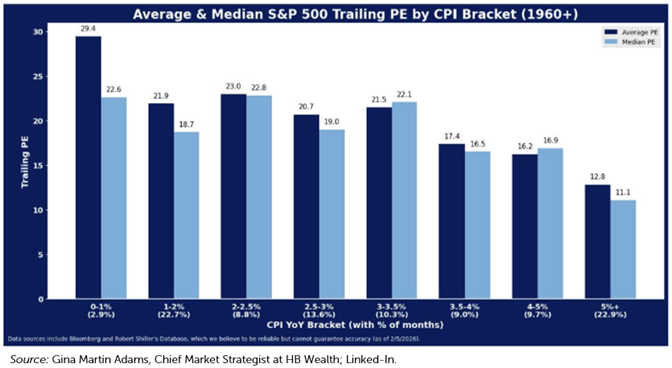
In addition to the long-term context for valuations, the risk of higher inflation over the coming months could prove to be quite challenging should commodity prices stay elevated. The chart below from Gina Martin Adams of HB Wealth shows that average P/E multiples take a big stepdown when inflation exceeds 3.5%. If the war extends longer than the market currently anticipates, inflation could be far more impactful to valuations.
Valuation adjustments in March were not exclusive to equities. Fixed income and alternatives suffered setbacks due to widening credit spreads from private credit fears. The cracks in the private credit market and declining equity valuations have given rise to increased volatility and the extreme commodity price surge has affected “Everything, Everywhere All at Once” as far as markets are concerned.
Portfolio Construction and Positioning
Geopolitical stress has taken center stage as the markets eagerly await a conclusion to the war in the Middle East. A resolution to hostilities and a normalization of energy prices would allow the economy to restore its pre-war growth path over time, but an extended war could derail the economic expansion. For now, corporate profitability remains very healthy and fiscal and monetary support are strong. With a new Chair of the Federal Reserve Board set to be confirmed by May and a mid-term election coming in the fall, adjustments to monetary and fiscal frameworks are likely.
Global markets have shown remarkable resilience given the disruption posed by the war. The benefits of diversification have proven to be quite effective at the onset of 2026 even though the month of March reversed some of the year’s early success. Relative valuations continue to favor broadening, and our portfolios are well diversified by geography, style and market cap.
Our Navigator process helps guides both short- and medium-term tactical adjustments:
- Mid-cap and international equities: These segments offer attractive valuations relative to U.S. large caps and provide long-term diversification benefits.
- Balanced exposure across styles: We maintain a mix of growth stocks poised to benefit from technological innovation and value stocks offering upside potential with an emphasis on cash flow and dividends.
- Fixed income remains compelling: Bond yields exceed the earnings yield of large-cap equities, and real (inflation-adjusted) yields are positive—supporting the case for continued fixed income exposure.
- Mortgage-backed securities: We see favorable risk-reward dynamics here, though tight corporate credit spreads warrant caution.
- Alternative investments: We continue to find meaningful opportunities in both non-correlated strategies and private market investments.
Constructing resilient portfolios capable of compounding effectively over time is our primary goal. Our foundation is rooted in discipline and diversification, and we remain mindful of risks to the outlook.
This material is intended to be educational in nature, and not as a recommendation of any particular strategy, approach, product or concept for any particular advisor or client. These materials are not intended as any form of substitute for individualized investment advice. The discussion is general in nature, and therefore not intended to recommend or endorse any asset class, security, or technical aspect of any security for the purpose of allowing a reader to use the approach on their own. Before participating in any investment program or making any investment, clients as well as all other readers are encouraged to consult with their own professional advisers, including investment advisers and tax advisors. OneAscent can assist in determining a suitable investment approach for a given individual, which may or may not closely resemble the strategies outlined herein.5
1) Source: “Everything Everywhere All at Once” is the title of the 2022 Oscar Winning film for Best Picture. The film received many accolades.
2) Source: OECD Interim Economic Outlook 119 database; OECD Economic Outlook 118 database; and OECD calculations.
3) Source: Bloomberg Data
4) Source: Bloomberg World Interest Rate Probabilities for comment on rates and various media articles from Bloomberg,
the Wall Street Journal, Linked-In et al. for the comment on “nullifying the benefits of OBBBA”.
5) Source: Market Returns reference the following indices: Large Cap – S&P 500, Mid Cap Growth – Russell Midcap growth, Mid Cap Value – Russell Midcap Value, Small Cap – Russell 2000, Developed – MSCI EAFE, Emerging – MSCI Emerging Markets, Aggregate – Bloomberg US Aggregate, High Yield – Bloomberg High Yield
OAI01490